Showing posts with label Evaluation. Show all posts

Wednesday, June 27, 2018

The Parable of the Two Farmers

Once there were two farmers who each had a vision of a wonderful crop, free of weeds and producing a great harvest.
The first farmer gathered all the seeds and spread them out, then began picking out the weed seeds from among the wheat seeds.
The second farmer sowed all the seeds right away.
Some time later the second farmer was busy at work pulling the weeds each day as the crop grew, while the first farmer was busy at work searching for and removing weed seeds in preparation for planting.
Eventually, the second farmer had a wonderful harvest. The first farmer had a lot of very clean seed.


(Just a little window into my world on a Wednesday morning.)

Thursday, January 1, 2015

2014 in Devotions

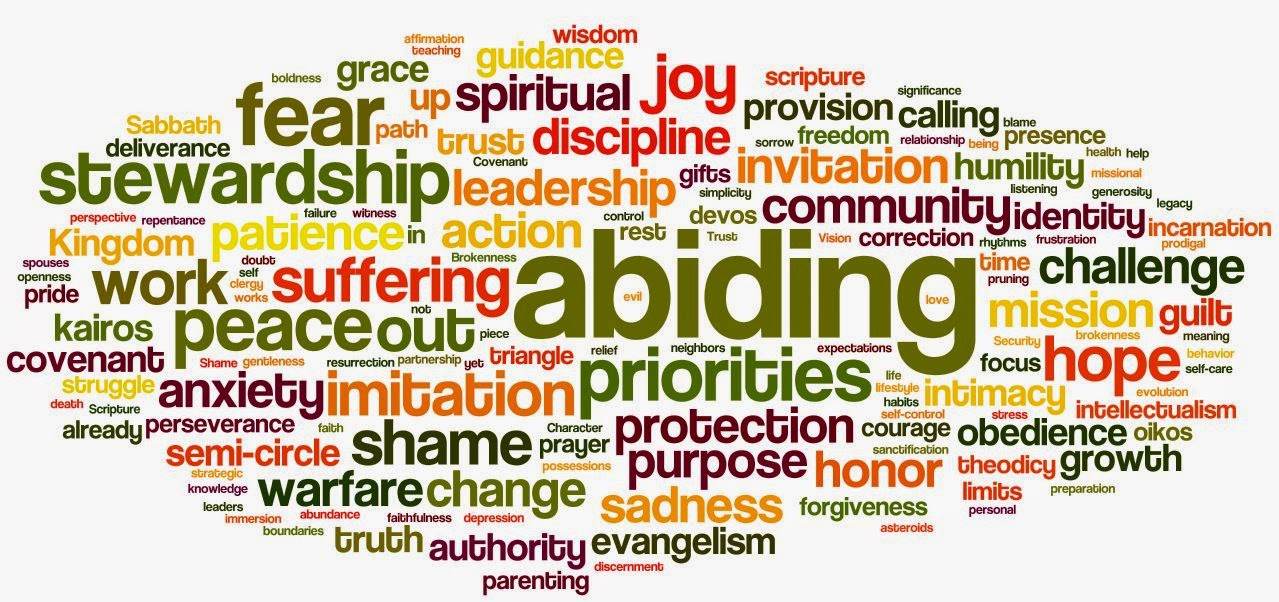
Here's a visual summary of the themes in my personal devotions over the last 12 months:


If you prune that down to the top 20 words, it looks like this:


And if you go all the way down to the top 5 words, you see this:


Not that you really need to know that much about what's been on my heart for the last twelve months as I read and reflect on Scripture of course, but I wanted to share with you the tools I've found that have made this little look-back reflection possible.

First, I've been using a simple journaling format that I learned from Wayne Cordeiro at New Hope in Hawaii.  It uses a SOAP acronym to provide structure (Scripture, Observation, Application, Prayer) and help keep things simple.  I've written more about that before.  What I may not have mentioned is that the journal invites you to create a Table of Contents as you go, and for each entry to record a title and some keywords that identify the themes in what you've written.  Here's what mine looks like:


I've been using this journaling tool for several years now and have begun using the keywords as a window into the past.  (The Table of Contents is also a HUGE asset when you need to find a verse on a topic for yourself or someone else.)

With that list of words as raw material, you can visualize it as above using the website Wordle. Paste your text into the box and BOOM!  A word cloud where the words that appear most frequently are shown in larger font.  Wordle gives you a lot of flexibility on how the visual is created... fonts, colors and alignment etc.  But you can also limit the number of words that will be shown from your content, which is how I made the three versions above.  (You can also make a Wordle from a document, or even from a website.  Try pasting in a whole book of the Bible sometime to see some interesting things about the topics that book is engaging.)

If you're not doing daily devos, I encourage you to start and I recommend the Life Journal as a great tool.  It's been a huge blessing to me!

Sunday, December 28, 2014

Musing on Metrics

A clergy group I belong to on Facebook got started talking about metrics and I chimed in (just a little bit). Thought I'd share some of that here for those who are interested:

"Metrics may not do a good job of telling the whole story, but they tend to tell you if there's a story you should be paying attention to."

"Much of the 3dm approach lends itself to metrics, which I appreciate:

Number of people in huddles.
Number of huddles meeting.
Number of people who are able to lead huddles.
Number of second, third... generation huddles.
Number & generation of Missional Communities."

"One key metric that anyone working in Post-Christendom should be tracking is adult baptisms. I think that one metric is like the canary in the coal mine if we dare to look at it.

For conventional congregations, I went so far as to develop an measure of "Evangelical Effectiveness" based on that: Number of Adult Baptisms per year per 100 people in worship. (Normalizes for the size of the congregation.)

I tried to get that metric placed in use in my Synod years ago - at least as a way of discovering the congregations that are *actually* effective in conversion growth. I was thinking if we knew which ones they were, we might be able to hear their stories and learn from them. Unfortunately, the proposal was met with disinterest and resistance I'm sorry to say.

(You can read more about that on my blog.)

"Going off in another direction... sometimes we measure what we do because it's easier to measure than other things that might be intrinsically more important. Butts and bucks are easy to count & so are adult baptisms for that matter. But we're trying to make disciples and help people *mature* in faith. What could we look at as "metrics" for maturity?

Many people stop pursuing that because they think things like maturity cant be measured. True enough. But they can be *evaluated.* Lots of "squishy" things can be evaluated... you just need to find a way to metri-fy it.

For example, years ago when I was (FINALLY!) getting my depression diagnosed, the doctor gave me a little inventory. "How often do you think about thus-and-such?" "How many times per week do feel XYZ?" and so on. Scaled responses like Never - Rarely - Sometimes - Often - All the time. He *scored* the inventory and that was a part of the diagnosis.

We *could* do discipleship growth assessments... if we dared.

Imagine an assessment about the presence of the following traits in your attitudes and behavior: love, joy, peace, patience, kindness, gentleness...

Are those things *more evident* this year than when you took the inventory last year?

For the truly courageous, we give the inventory to the five people closest to us and let THEM do the eval!

Ready to have your kids and spouse weigh in on the question "Has (your name here) become more patient over the last year?" Does (name) have more self control?"

Sunday, February 24, 2013

Evaluating Discipleship - Head, Hand and Heart

Some recent conversation about evaluating ministry in a Facebook group got quickly bogged down in typical struggles. Butts in pews and bucks in the offering plate can be measured, but don't tell the story etc. I brought a different perspective in these words:

"Most of what we are talking about evaluating (whether numerically or otherwise) are, I think, merely proximate targets. They are *close* to what's important, but not the thing itself. If our goal is to make disciples, then our real evaluations should be on the actual traits that describe such people. For convenience (and alliteration) I like to use three categories: Head (knowledge), Hand (practices), and Heart (attitudes). As it turns out, I think those are listed in order of ease of evaluation, and in reverse order of importance. If we never get around to really assessing how we are doing in shaping people into 
Christ-likeness in those three dimensions, then I assert we never really know if we are being effective or not.
...and to anticipate a question, yes, you certainly can have a meaningful evaluation for "Heart" factors e.g. love, joy, peace, patience etc. I myself have taken depression inventories, which are a reverse indicator of joy in a way. Also, spouses can be readily enlisted to provide evaluations along these lines: "Honey... I've been attending church for a year now. Do I seem more kind or patient to you?" (I'm thinking that last bit was probably only 5% facetious. Maybe less.)"

Wednesday, May 4, 2011

Adult Baptisms per 100 People in Worship

In connection with my previous post on helping congregations learn from each other about doing evangelism, my friend Ron Amundson was struck by the chart below that is included in the background section of the discussion site.  So I thought I might lift it up here as well.

The chart shows the number of adult baptisms per year per 100 people in worship in a (non-representative) sample of 27 of the 107 ELCA congregations in the Saint Paul Area Synod.  (Since most of them are less than one per year on this measure, the data was actually produced by averaging worship and baptism statistics for the six-year period of 2000 through 2005.  This kind of data is publicly available, by the way, on the ELCA website. Once you find the congregation you are interested in, look for the "Full Trend Report" link for a wealth of information.)


A couple of things to note:

  • Some congregations appear to have no effective evangelism (by this measure) with no adult baptisms over the six-years represented in the data.
  • Among congregations that do report adult baptisms over the last six years, there can be a ten-fold difference in effectiveness.
  • There is no evidence here that larger congregations are more effective than smaller ones (by this measure.)  The data suggests that the reverse is likely to be true.

So.  More food for thought.

Tuesday, May 3, 2011

Learning to Evangelize... Maybe

This post is a bit of inside baseball/local interest mostly for my fellow Lutherans in the Saint Paul Area Synod. It's about a resolution I wrote for our upcoming Synod Assembly about evangelism.

In a nutshell, it's about discovering which congregations are being more effective among us and drawing out stories from them that the rest of us can learn from.

"Actually, I'm a Resolution."
To get this Resolution to the Synod Assembly, I brought it first to my Conference Assembly where it passed - but just barely, which was a surprise to me.

Next it was reviewed by the Synod's Reference and Counsel Committee which also had reservations and is recommending that the Synod Assembly not vote on it but rather have a discussion of evangelism at tables at the Assembly.

Well, there are 17 days left before the assembly and I'd still like to see this thing passed so I set up a little website where people can read and discuss it. It's public so anyone who wants to can join in. You can find it here at Learning to Evangelize.

We now return to our regular programming.

Wednesday, January 12, 2011

Navigating the Asteroid Field: Spiritual Growth Practice

One metaphor I keep returning to in my thinking about how to pursue the life of faith with intentionality is the asteroid field.  I haven't yet written about it here. but did bring it up recently over on Felicity Dale's Blog.  The topic there had to do with the tension between tending internal relationships vs. outreach to others, but that raised the question of whether there is a regular "sequence" to these things or not.  (E.g. "FIRST we get close, THEN we can reach out to others.")  In that context I dropped in my thought about navigating in the absence of a stable sequence or pathway.  I think it applies both to groups and individuals.  At any rate, here's the comment from that conversation which will at least introduce the metaphor for us here.


The critique of "sequentialism" resonated with me. It's like the traditional way of navigating where you have a map and a route and just go step by step. But that only works if the terrain stays put! These days I think navigating as a faith community is more like flying your moving spaceship through a field of randomly drifting asteroids. There is no "path," and if you start trying to chart one the asteroids will have moved before you get it finished so it's obsolete before it's done. Navigating in this environment is, I think, done by quick orientation followed by incremental movement, then repeat. And orientation means knowing what's right next to you as well as where you ultimately are trying to go.

In practice, I think that calls for the listening to God and each other that others have mentioned. We Refresh our awareness of where we are and where we are going, then Respond. So the path forward isn't laid out in advance as a sequence A to B to C to D etc. Rather, the sequence is replaced by a discipline: "(Refresh, Respond) Repeat."
I think, if we do that, then the original question about community vs. mission gets answered over and over as God leads.
Thoughts on an (R,R)R practice for faith life?  I'd love to hear them.

Monday, September 13, 2010

Sunday Services: the Blind Spot and Sacred Cow in Church Decline

Dave Householder has written a bracing post about the decline of the Lutherans in North America that is well worth reading. He gets extra credit for leading off with this; "This article is not just for Lutherans. It applies to most North American faith families." I expect the comments are really good too, but with 90 at last count I confess I lacked the fortitude to actually read them all!

He cites ten factors contributing to decline, including:
  • Low birth rate
  • Poor retention of the babies we do have
  • Staggering ineffectiveness in evangelism
  • Unwelcoming if not toxic parish communities
  • Little or no effective use of media
Decline has been an ongoing topic of my blog. I've integrated several of his points into the "pond metaphor" where you can easily see why the church used to grow but is in decline now. I even threw together a metric for "evangelical effectiveness" that is pretty jarring to look at.

But after reading David's post I still think that one of the most significant issues is going unnamed: the inherent ineffectiveness of Sunday morning gatherings, both for discipleship and for evangelism. Yet we persist in making these gatherings the centerpiece of our faith-life culture, and investing the vast majority of our time, energy and money in maintaining them as I've discussed here. Sunday morning, large group, presentational, professionally led, property-dependent worship services are, I'm afraid, both our biggest blind spot and our most sacred cow.

And this central assumption about the way to "do church" is perhaps the most unifying feature of North American Christendom. It can't be much of an overstatement to say that we all do it that way. No wonder then, that the decline spans the decades so readily and cuts so easily across denominational lines, and the liberal/conservative divide.

Large group gatherings are not bad. But as the centerpiece of faith practice they can never be effective in spreading or nurturing the faith. That requires face to face, heart to heart conversation, which is notoriously difficult to have in a pew, disrespectful during the preaching, and drowned out by the performance be it the organ or the band.

Wednesday, May 19, 2010

Evaluating Wellbeing - a Tool for the Church?


Gallup has launched a new book and program focused on Wellbeing. Their StrengthsFinders work has been extremely valuable to me so I expect this will be good stuff as well.

It uses an online assessment questionnaire that you can take repeatedly in order to see changes in your wellbeing over time and the influence of events and actions you take. Suggestions are provided for making improvements in the five "Essential Elements" of Wellbeing their material presents:
  • Career
  • Social
  • Financial
  • Physical
  • Community
A couple of things come quickly to mind:

No "Spiritual" aspect to wellbeing? I can't imagine that's an oversight, so they must have reasons for not going there. I'll be interested to learn what they are.

Social and Community Wellbeing are two different things. The fact that I was surprised to see them listed separately is telling evidence that I really am a part of my Western culture, which is generally so focused on the individual that issues around community are generally off the radar.

What if your congregation picked this up and ran with it? Suppose your congregation made intentional, ongoing work with this tool a core practice of your community life (after adding in a Spiritual Wellbeing component, of course)? Imagine adding a faith-based perspectives to conversations on Career and Financial Wellbeing? Do you think this might be something your people would value and benefit from?

Do you think they might, just possibly, mention it to their friends, neighbors and coworkers?

Suppose you offered workshops and support groups around this to the community around your church... gave them the books for free as a sign of your commitment to the practice of being a blessing to others... made the sessions completely non-religious but offered an opt-in conversation after each gathering for those who wanted to add the faith dimension... I'm just thinking out loud here...

Do you think people outside your church might begin to see it as an asset to the neighborhood, a partner in the community?

I wonder!

Saturday, January 16, 2010

Church Decline in the Public Eye

The decline of the church is something that borders on an "open secret" - "widely known to be true, but which none of the people most intimately concerned is willing to categorically acknowledge in public." (Lifted that from Wikipedia.)

If you want to see evidence of that, take a look at this Bizarro cartoon in todays Pioneer Press, near the top right corner. It actually points out both the reality, and the denial of those "most intimately concerned," in one punchline.

When church decline is well enough established and so widely understood that it can be the source of humor in popular culture, it's way past time for us to do something about it.

Tuesday, December 1, 2009

The Sticking Point: Social Density

A Facebook group I belong to associated with Luther Seminary recently started a discussion on this question:

What are the sticking points of your community of faith that keep you all from becoming a missional congregation?

I thought I'd take a crack at that and here's what I posted:

The sticking point? If only there were just one! I see a host of impediments to the emergence of a missional culture - everything from clericalism and Biblical illiteracy to the hyperindividualism and consumeristic ethos of our civic culture. But there does seem to be one factor that exacerbates all the others and is the place I keep coming back to when I try to decide where to invest my energies.

There is a general lack of substantive relationships.

You can easily unveil this by looking at the one-anothers that describe healthy Christian community. For example, how common are relationships in our churches that are substantive enough to allow people to actually "admonish one another?" Not very.

Culture change - like faith itself - travels from person to person like a virus. You can stop a virus cold (so to speak) by isolating people from each other. Similarly, our community relationships are generally too distant to support a culture-change epidemic. We don't "breathe each others air" enough to transmit anything.

Our primary gatherings may look like good places to catch something - Sunday services are something of a crowd scene. But there is very little relational contact that can take place in that setting. You may catch a cold by passing the peace, but you won't catch a missional culture that way.

Invest in small groups? Of course. But that's typically done as an add-on to Sunday services, as icing on the cake of everything else that's already entrenched in conventional congregational life. Most of our time & energy goes towards the large gathering which tends to have a small impact on a large number of people. Small groups, that have a larger impact on a smaller number, get the leftovers. That's a fundamental mis-alignment. (To see it graphically as a napkin diagram, go here: http://bit.ly/Misalignment.)

To switch metaphors from infection, think in terms of a nuclear chain reaction. To make that take place, the atoms have to be at a high density, packed very tightly together. Then as the neutrons fly, they release even more and the reaction multiplies.

Our "social density" is not high enough to support a "chain reaction" of missional culture change. In contrast, that's just what you see when the Church is "packed very tightly together" under persecution, often resulting in "explosive" growth.

So if I had to pick one factor above the others to focus on, I guess it would be social density. That's why I continue to be drawn to the house church movement - an eminently Lutheran expression and a subject for another time!

Saturday, March 14, 2009

Twin Peaks: Resource Allocation and Effectiveness in Promoting Spiritual Growth in Conventional Congregations

Dontcha just love that title? It's just like the stuff I used to write back when I was a molecular biologist.

I have an observation.

In conventional congregations, the larger a gathering is, the more resources are invested in it. For example, the typical Sunday morning worship service consumes the vast amount of the resources available. This is true I believe in terms of staff time, funds and physical space. (It's probably true of member time investment as well, to the extent that they invest their time in their spiritual life.)

Here's how that looks:


(You'll notice that I drew that on a napkin to underscore the sophistication of this analysis.)

Thus far, I've restated the obvious.

I also have a hypothesis: The smaller a group is, the more effective it is in promoting spiritual growth (to the extent that the group focuses on spiritual life).

So on one extreme you have spiritual friendships, marriages, mentoring relationships and "two or three are gathered" accountability groups. Next up come the familiar "small groups" and Bible studies. At the other extreme is, well, Sunday morning worship.

Here's how that looks:


The obvious question here is; "What's wrong with this picture?" To which I would respond; "Well, it looks to me as if resource investment in conventional congregations is 180 degrees out of alignment with the strategies that are most effective in promoting spiritual growth."

But here's a more interesting question: "What would congregational life look like if we realigned our resource investment to reflect this?"

Thoughts?

Monday, January 26, 2009

God's Short List


I volunteered the other day to read some theology and blog about it in connection with a project Tripp Fuller is doing over at Homebrewed Christianity. He got so many applicants he's having to sort us out with some questions on a registration form, including this one:
What is the most interesting God question in your mind today?
So, with a little box to fill in, here's what I discovered I had to say about that:
I'm interested in minimalist Christianity from a practical standpoint, because the smaller something is, the faster it can be copied and spread. I blogged about this under the heading "Viral Christianity" here: This drives my interest in Simple Church, House Church, Organic Church, Todd Hunter's "Three is Enough" groups and so on. It also is part of an ongoing exploration into my own theological heritage (Lutheranism) which, while it can be as baroque as the next guy's, has certain features lurking at it's core that I think make it ripe for radical self-pruning.

That's what I think about anyway. To re-frame it as an answer to your question, maybe I'd put it this way; "What's on God's short list of the things that really, really mater for the Church?"
Nothing like a good question to get things moving.


So, what do you think is on God's short list?

And what would your life, and your church look like if you used the same list?

Thursday, January 1, 2009

Outcome-Biased Christianity?

Phyllis Tickle had an interesting post at the Emergent Village site that led me to write a comment I wanted to share here as well. She was writing about how people are rethinking the very definition of church and Church (which often ends up significantly shaping how people actually live as C/church.) She offered this expression:
...as of right now, I believe both church and Church are “a body of people delighting in God, the Father, God, the Son, and God, the Holy Spirit.”
Here's what that triggered in me:
I like the feel of C/church as a “body of people delighting…” because it moves away from trying to define C/church on the basis of it’s attributes, and instead looks at how one might recognize C/church through it’s actions and attitudes. (I think that’s what you mean when you say it has “predication.”)

In my own thinking, I’ve begun to look for C/church as the body that, because of its delight in its relationship with the God revealed in Jesus, lives into three outcomes:

  • Growth of individuals into Christlikeness,

  • Growth of the C/church body itself (deeper in relationship among members, wider in drawing more into the body), and

  • Growth of the Kingdom beyond the C/church (as seen in justice, mercy, kindness, abundance etc. for all.)

To me, that expression provides the necessary specificity by linking C/church directly to Jesus, while also allowing for enormous diversity of belief and practice around him as the center.

I thought about referring to this as "Outcome-based Christianity" but that's not quite right... The basis isn't in the outcomes, so much as the relationship which impels us to pursue them. But I am drawn to the idea of being "outcome-biased." For one thing, I think it steers us away from investing too much into theologizing on the front end about what the C/church is or isn't. And for another, it pushes us past simply focusing on what the C/church does (e.g. we do "word and sacrament" or we do "worship, fellowship, discipleship, ministry and evangelism") without at least checking to see if all our activity is resulting in anything or not.

I think I'll continue to muse on that, and I'd appreciate some feedback, particularly about how this might help shape the life of the C/church in practical ways.

Monday, February 11, 2008

The Huckabee Bible Quiz


If you’ve been following the presidential primaries, you may have noticed that Mike Huckabee often refers to Bible stories in his speeches. What you may not know is that when he does that, most people in the U.S. have no idea what he’s talking about!

A recent story done by National Public Radio took several Biblical allusions from Huckabee speeches and went in search of people who could identify them. Most could not, which wouldn’t surprise you if you knew that 50% of Americans (and that includes Christians) can’t name any of the four Gospels, or know that Genesis is the first book of the Bible. But it should surprise you to learn that every person they asked had been raised in a Christian home and gone to Sunday School.

Want to see how you’d do on the quiz? Here are the four quotes. Do you know the Bible story each one comes from? I'll put the answers in the first comment to this post. In fact, why not add a comment yourself and let us know your score!

1. "It's the same power that helped a little boy with two fish and five loaves feed a crowd of 5,000 people."

2. "Sometimes," the former Arkansas governor told his supporters, "one small smooth stone is even more effective than a whole lot of armor."

3. "We've also seen that the widow's mite has more effectiveness than all the gold in the world."

4. "It's almost like when the prophet was looking for a king. He came down, looked through all of Jesse's sons, went through a whole bunch of them, and said, 'Is this all you got?'"

I hope you did well.

Why does this matter? Well, consider this: Huckabee has a message he is trying to get out to people. He is using Bible stories as a way to get it across. But people will never get the message if they don’t know the stories. In the same way, God has a message that He is trying to get out to people, including you. God uses Bible stories to help get the message across. But if you don’t know the stories, do you think you’ll understand the message?

Have you read your Bible lately? I highly recommend it. After all, Someone is trying to communicate with you.

Wednesday, June 6, 2007

Evangelical Effectiveness

A friend of mine who leads a small cell group network tells me that about 1 out of 10 people in the network is an adult convert who came to faith throgh the minstry of the groups.

Now, in my local group of 14 ELCA congregations, the combined average worship attendance comes to about 6,000 people per week. If 1 out of 10 of them were adult converts, that would be 600 people. But a study I did of the annual reports from the congregations found a total of 72 adult baptisms over the past 6 years. In fact, the average number of adult baptisms each year per 100 worshippers among these congregations comes to 0.2.

Put another way, every batch of 100 worshippers in our congregations takes, on average, 5 years to bring one person to Jesus.

This is one reason I'm interested in cell groups and house churces.

Now, is this really a fair comparison... networked cells and conventional congregations? Probably not. It's apples and oranges, I admit it.

But it does make me think.

Perhaps we should be planting apples.

Tim

Tuesday, May 15, 2007

Do You Have Joy?

Well, I posted a question about evaluation on an e-mail forum for missional church leaders... asking if anyone was doing evals, if so what are they like etc. and guess what - no one even responded! What's up with that?! Meanwhile they're having a conversation about how clergy can't define "success" or even ask the question. Hellooo! I tell you, it's a good thing I'm nobody of any importance or I'd really be irritated for being ignored like that. ;) Anyway, I reposted my original question so we'll see if that helps.

For now, let me see what I can do. For a framework, I'm going to use Rick Warren's Five Purposes (Worship, Fellowship, Discipleship, Ministry, Evangelism). To be fair, I sould point out right away that Rick actually does have an evaluation tool based on the Purposes. What I'd like to develop is something a bit simpler and not linked to some of his other specialized terms. You can read my take on the Purposes presented in a Tree metaphor here.

So, if we start at the "roots" of the tree, that would be our realtionship with God, and for me, the best thing to look for there is joy. Jesus said he wanted us to have complete joy (John 15:11). So here are some questions around that.

How often are you experiencing joy in your life that comes simply from knowing and being known by the God who loves you?

How well does your joy hold up when you endure bad circumstances?

Can other people tell you have this Joy?

What is your overall sigh-to-smile ratio? (The percentage of time you spend sighing vs. smiling.)

I believe that growing in faith will result in more joy and more visible joy. I think Churches should let people know that's part of what they should expect. Churches should help people discover and experience that joy, and should evaluate for progress to be sure they are getting the job done.

And if people don't have any joy, then I don't think we should press them on anything else until we've helped them grow into that.

So - how goes it with you? Do you have joy?

Tim

Friday, May 4, 2007

Spiritual Evaluation?

Why is it that we never evaluate spiritual growth?

When something is important to us, we usually find some way to evaluate it. It's important that our kids get an education and actually learn things in school, so we give them tests and grades to see how it's going. My health is important, so my doctor routinely does various blood tests. Airplane components... infant car seats... promising pharmaceuticals... it's important that these things actually work. That's why they get tested and evaluated.

But in the Church, I can't recall ever encountering a significant attempt to find out if people actually grow in faith, actually mature.

The "annual physical" is a common idea. Where's the annual spiritual?

Eugene Peterson embellishes a bit here, but his The Message version of 1 Corinthians 13:5 really lays it out straight:

"Test yourselves to make sure you are solid in the faith. Don't drift along taking everything for granted. Give yourselves regular checkups. You need firsthand evidence, not mere hearsay, that Jesus Christ is in you. Test it out. If you fail the test, do something about it."

So tell me, if you paid a visit to The Great Physician and he sent you out for some labwork, what kind of tests do you think he'd have them run?

What's the spiritual counterpart to a cholesterol test?

Tim