Summary: Introduces a simple home exercise (great for families) that helps one grow as a disciple by focusing on a "Fruit of the Week." Based on the list in Galatians 5 which begins with "Love, Joy, Peace, Patience...."
A record of my journeys and conversations as I explore my life of faith, and the life of the Church, outside of conventional congregations.
Tuesday, January 29, 2019
"Road Trip" Sermon #16 - "Growing Good Fruit"
Summary: Introduces a simple home exercise (great for families) that helps one grow as a disciple by focusing on a "Fruit of the Week." Based on the list in Galatians 5 which begins with "Love, Joy, Peace, Patience...."
Monday, October 1, 2018
Tim's Toolbox: ABIDE - Start Here
To find the full set of tools, go to Toolbox Central. Here is a sermon on Abiding as well.
_______
Jesus teaches us that love is the center of life and faith. His summary of what’s truly important is that we should “Love the Lord your God with all your heart… and your neighbor as yourself.” (Luke 10:27) We are also taught that being loved comes before being loving. As it says in 1 John 4:19 “We love because he first loved us.” So the starting point in life is learning to be loved, which is surprisingly difficult for many of us!
Jesus uses a particular word and a powerful image to talk about remaining open and connected to God to receive that love. The word is Abide, and the image is the Vine and Branches in John 15:1-11. “I am the vine, you are the branches... Abide in me as I abide in you. Just as the branch cannot bear fruit by itself unless it abides in the vine, neither can you unless you abide in me… Those who abide in me and I in them bear much fruit, because apart from me you can do nothing.” It’s hard to overstate the importance of abiding for the branches. Not only is abiding in the vine what allows the branch to bear fruit, it’s what keeps the branch alive in the first place! The Pipe metaphor points this out as well, reminding us that there’s no outflow without an inflow first. That’s why the icon for Abide has a circle at the top of the pipe shape, to focus our attention on the inflow first.
To abide then is to remain intimately connected to God and receiving the flow of love as a way of life. And as we live moment by moment, it’s a sense of resting in that security. Abiding is what’s envisioned for us when Jesus invites; “Come to me… and you will find rest for your souls.” (Matthew 11:28-29)
We believe that God loves us, loves us all the time, and loves us just as we are. But for many people, ”being loved” doesn’t go much further. It’s something they believe, but not something they experience. It’s like a radio station that is broadcasting all the time but we’re not listening to it. How then do we “tune in” to the station? How do we learn to Abide?
The answer to that may be different for different people, and it may be different for the same person at different times! But a good starting point is to look at the beautiful moment of abiding between Jesus and the Father at his baptism. What we see there is Jesus simply listening, “soaking it in” as the Father declares three things to him: You are my son, I love you, and I’m pleased with you. (Mark 1:9-11) Jesus abides constantly in the relationship declared in those three statements. That relationship is his source of strength and direction for all he does and endures.
Learning to be loved can begin by spending time in prayer simply listening to the Father just as Jesus did. Listen to the Father speak those same words to you. Let it wash over you and soak into your heart. Physical experiences can also help us re-center on the spiritual reality of God’s love for us. For example, pausing in the moment when the warm water of your shower runs down over your head can be a powerful reminder of the peace and well-being you have with God’s love showering down on you. Wrapping a comforter around your shoulders can be a physical representation of God’s tender embrace.
John 15:16 (I chose you)
Sunday, November 5, 2017
"Road Trip" Sermon #3 - Abiding is Job #1
Title: "Abiding is Job #1"
Summary: As disciples of (apprentices to) Jesus, we want to learn from him how to abide. A great example he gives us is in Luke 3:21-22 which tells about Jesus' baptism. We see him there, in prayer, having a moment of "quality time" with the Father and hearing the Father remind him; "You are my son, whom I love; with you I am well pleased." This is a simple, clear and direct practice that we can learn from him: find ways to "soak it up" as we listen to the Father declare the same things to us. The most straightforward way to do this is by having a moment of listening prayer every time you take a shower or bath.
Slides: Click here to view slides in a new window.
Video: View the video from Saturday November 4th here.
Thursday, December 31, 2015
The Message 100 - Book Review
I was very pleased to receive a copy of The Message 100 by Eugene Peterson for review a while back. I'm happy to recommend it, first and foremost because The Message version itself is hugely beneficial for reading, and second because the new arrangement of the books of the Bible that you find in The Message 100 has some valuable features as well.A quick word about the translation itself. I like to refer to Peterson's excellent work as a "rendering" of scripture. Though based on the original language manuscripts, Peterson allows more freedom in bringing it into English than one would use in a formal translation. His rendering is at least a paraphrase, and at times makes moves that I would have to call interpretations. But the vitality and vibrancy of his version is so helpful in "hearing" scripture that I am always enthusiastic to recommend it to people for general reading and as a companion for formal Bible study. Reading The Message has improved my "scholarly" understanding of scripture, but more importantly, helped the Lord shape my heart in wonderful ways.
This new version makes two significant changes in how a reading Bible is organized. First, it divides the text into 100 readings. That simple change gives you an encouragement to read the whole Bible (who doesn't want to get to 100?) while at the same time avoiding the problems associated with so many other "read through the Bible" plans which is simply this: failure. I don't know how many times have I gotten behind in some daily reading plan and faced the decision to either skip a batch of readings and "press reset" to (FAIL!) or binge-read as fast as possible in order to "catch up" (faking success = FAIL!) The 100 version invites you to keep at it and take your time. It's a grace goal... one that comes with a finish line but without a deadline. How cool is that?
The second change in the 100 version is more significant, and more subtle. In many places, the books of the Bible have been re-ordered.
Finally, Acts follows Luke as the sequel it was written to be! But that's just the start...
Anyone who's ever tried to read the Bible "cover to cover" has run into the Kings-Chronicles issue. You work your way through 1st and 2nd Kings and then here comes 1st and 2nd Chronicles going back over the same territory you just finished. It's confusing and a bit frustrating to feel like you are "re-reading" all that stuff, even if you are aware of the significant differences between Kings and Chronicles. Some reading plans deal with this by interweaving the two tellings, and that helps especially if you read the various Prophets along the same timeline as well. (Wayne Cordeiro does an excellent job of this in his Life Journal materials.) In The Message 100, Peterson leads you through Kings first, and then introduces Chronicles after you've gone through much of the prophetic literature and spent time in Exile with Daniel. That brings you to the point in the story when the Chronicles were written as a way to re-engage the people's history in a new situation. That one change actually gave me a new appreciation for the first eight, tedious, chapters of genealogy in Chronicles. (Actually, not so much a "new" appreciation as a "first ever" one.) After all they've been through and the ruin they brought on themselves as a people, the listing of ancestors up to the present survivors returning from exile has a way of saying "... and we are still here! After all this, all these generations, we are still here!" The placing of Chronicles helped me to catch that.
Another notable re-ordering is placing the Gospel of John in a final section along with the letters of John and Revelation. With the similarity of voice and vision in these books, it's intriguing to think about the way that reading them together will cast light on each of them.
I'm also intrigued by the decision to put Job in between Genesis and Exodus as part of the section on "Beginnings." No explanation is offered, but to me it helps to suggest a similarity in genre of the two books as something different from what we moderns think of as "history." And I think it also works as a way of "setting the stage" for the story of Scripture as both Genesis and Job get us thinking about the challenge we face in the human condition.
Each of the 100 readings has an introduction written by Peterson. They are very helpful in keeping you oriented towards what's going on and what the readings are pointing towards. Especially here in these introductions can you hear the voice of Peterson the pastor, and some of the material is even drawn from his sermons. Another great gift he offers us.
The one thing I wish for that's not in the book is some commentary on his decisions for re-ordering the books of the Bible. But aside from that it's another wonderful piece of work from a man who has made a great contribution to the faith and life of many people, myself included.
Thursday, January 1, 2015
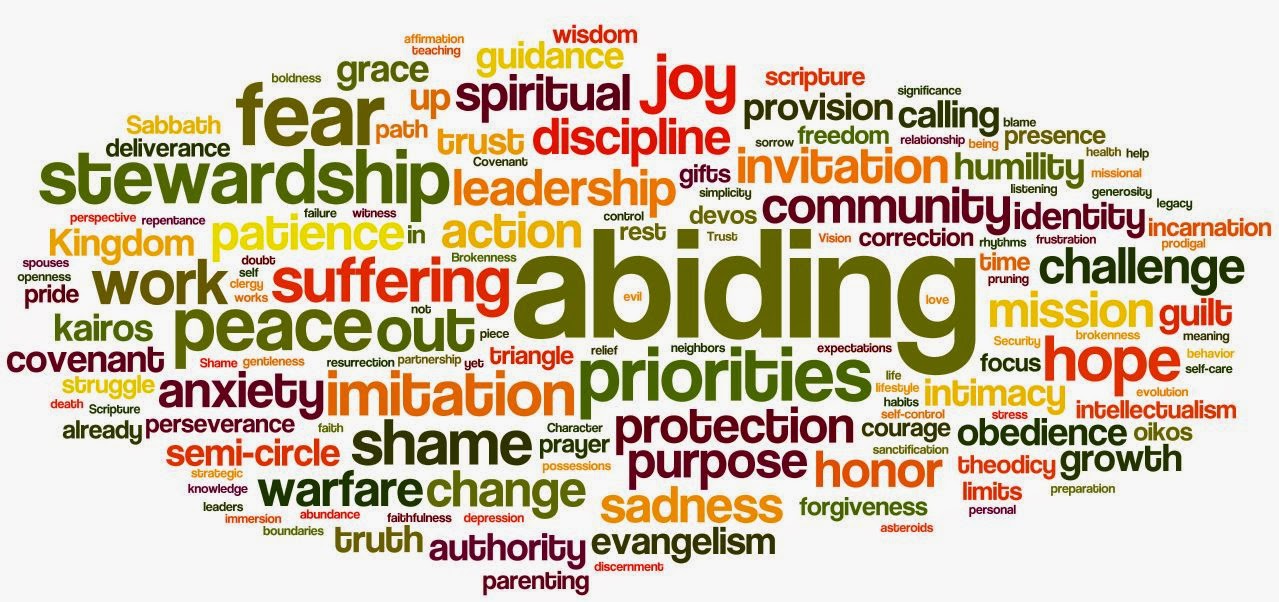
2014 in Devotions
If you prune that down to the top 20 words, it looks like this:
And if you go all the way down to the top 5 words, you see this:
Not that you really need to know that much about what's been on my heart for the last twelve months as I read and reflect on Scripture of course, but I wanted to share with you the tools I've found that have made this little look-back reflection possible.
First, I've been using a simple journaling format that I learned from Wayne Cordeiro at New Hope in Hawaii. It uses a SOAP acronym to provide structure (Scripture, Observation, Application, Prayer) and help keep things simple. I've written more about that before. What I may not have mentioned is that the journal invites you to create a Table of Contents as you go, and for each entry to record a title and some keywords that identify the themes in what you've written. Here's what mine looks like:
I've been using this journaling tool for several years now and have begun using the keywords as a window into the past. (The Table of Contents is also a HUGE asset when you need to find a verse on a topic for yourself or someone else.)
With that list of words as raw material, you can visualize it as above using the website Wordle. Paste your text into the box and BOOM! A word cloud where the words that appear most frequently are shown in larger font. Wordle gives you a lot of flexibility on how the visual is created... fonts, colors and alignment etc. But you can also limit the number of words that will be shown from your content, which is how I made the three versions above. (You can also make a Wordle from a document, or even from a website. Try pasting in a whole book of the Bible sometime to see some interesting things about the topics that book is engaging.)
If you're not doing daily devos, I encourage you to start and I recommend the Life Journal as a great tool. It's been a huge blessing to me!
Friday, August 17, 2012
Piano Keys and Faith Keys
- Caring
Conversations
- Family
Devotions
- Family
Service Projects
- Family
Rituals and Traditions
Monday, May 7, 2012
Spiritual Navigation among the Asteroids
Launching on Sunday May 20th, an event called Spiritual GPS (Growth Plan Sunday) that will become a "quarterly" practice of rebooting one's faith journey. Built on the metaphor of "The Asteroid Field" which says that in a dynamic/chaotic environment (i.e. modern life) there is no map, so you have to navigate by constant course correction: OAR - Orient, Act, Repeat.
For more on that, and to see my video introducing the asteroid field concept visit the Gethsemane Spiritual Growth page. This is "free and open to the public" as they say.
Got questions or comments? I'd love to hear them here!
Monday, October 17, 2011
Sermon Writing and the Stewardship of Time
"A recent question here asked about time spent on sermon prep. Eight hrs/week was mentioned, as was the "1hr per minute" rule. MLK Jr. apparently clocked in at 15hrs. I confess, this makes me wonder about the stewardship of time. What if, say, even once a month, you took 6 hours and spent them with a group of three people instead. Maybe 2 hours at a time on Monday, Wednesday and Friday. Talk with them about their lives and faith, pray and study scripture together to see what Jesus is saying to them these days. Then on Sunday, the four of you spend 20 minutes in worship as a group sharing with the congregation what God has been up to among you over the past week. Question: would that be more beneficial to the Kingdom than the usual 8 hours and a sermon from you? Be sure you factor in the value of life-change experienced by the three people (and you!) over the week. What do you think?"
Monday, March 28, 2011
Two or Three... is that it???
When you read Matthew 18:20 - "For where two or three are gathered in my name, there I am with them" - how does it sound to you?Do you hear something like this:
For even where merely two or three are gathered in my name, there I am with them?
Does that sound like the voice of Jesus coming through? Or is it more like the voice of our culture which, even though it it profoundly individualistic, still lives by the more is better, bigger is better value system?
How deeply has this taken root in the way we envision our faith communities? It's pretty common to find that the Kingdom logic runs the opposite direction from "worldly wisdom." Have we missed the boat and are we doing church upside down (or "backwards" as I argued in my napkin diagram here?)
Sure looks like it to me.
For more reflection on "two or three" in the Bible, take a look at this post from my friends over at Church Multiplication Resources.
Wednesday, March 9, 2011
Spiritual Fruit-of-the-Week for Lent
My wife and I talked with our daughters (14 and 9) about what we'd like to do for Lent and we came up with the idea of picking one of the fruits of the Spirit (unintentional pun there, sorry about that) and all of us focusing together on it for a whole week. Then the next week, we'll focus on a different one and so on. This led to a very interesting conversation about which fruit was most urgent to get started on. Kindness and Gentlenes were top contenders, but Self-control won out so we're off and running with that one as of today.
I made a little billboard of sorts to go on our table as a reminder with a complete set of fruits on sticky-notes tucked inside so we can swap them out from week to week. We're also going to use this to help us all memorize the set of 9 in order by the end of Lent. (I set up the billboard so you can hide the list while you try to put the notes in order, then open it up to see if you're right. How slick is that?!)So if you need an idea for intentionally shaping your faith while helping your kids to learn from your example, there you go. If it's helpful, pass it along. Either way, have a blessed season.
Tuesday, January 25, 2011
"Greenhouse" Organic Church Workshop offered in Minneapolis, March 2011
What's a Greenhouse?
In a nutshell, a Greenhouse training does two things:
- Helps participants to reground their thinking about Church in "organic" terms as a simple, living organism that readily grows and reproduces. Much of the time at the training is spent exploring how that looks in practice, both as outreach and as discipling believers.
- Invites participants to follow up on the training by gathering monthly through the following year for encouragement and supportive accountability as they begin to pursue this kind of "missional living" in the context of natural relationships.
For more specific information, contact my friend Katie Driver who is the local coordinator and will be one of the presenters. You can register here. For more of my thoughts and opinions about it, read on.
Although the Greenhouse training has good content in several areas, that's not the main reason I suggest you go. Frankly, good content isn't that hard to find these days and you can buy a lot of books for the price of this registration. What makes this worthwhile is that it pulls together three things that I think are key to Kingdom work - whether you're talking evangelism, discipleship or social ministry for that matter:
Simplicity. Lots has been written about simplicity. That's ironic, that is. Simplicity is vital for something to be easily transmitted and replicated. That goes for churches as well as viruses. The Greenhouse training works with a very simple expression of church, simple in both written and in human forms. That's good.
Substantive Relationships. Relationships where people feel safe enough to get below the surface of life are foundational, both for people to come to faith and for believers to mature in faith. This is one reason why conventional congregations struggle so much under the burden of maintaining a weekly large group gathering that inherently can't facilitate those kind of relationships. The Greenhouse training focuses on equipping people for exploring faith together in groups of 2 to 4 as normative. It offers one simple tool for people to use in self-facilitating such groups, but only as an example or as one resource they recommend.
Intentionality. This truly is the linchpin. Even mediocre ideas that actually get implemented will probably show more results than great ideas that are left on the shelf. I think the Greenhouse folks know this, which is why the real goal of the training is not simply to deliver good content to people. It's to lay a foundation for the formation of supportive accountability groups. (That's my term. They call them Greenhouse Monthly Gatherings which sounds much more fun and friendly and is probably a better term for that reason.) At the end of the training, they invite those who are interested to begin meeting monthly to encourage each other as they work to live out what they have learned. And note how the monthly meeting is not the main event. Rather, it plays a supportive role to the weekly gatherings of people in groups of 2-4, most of whom have not had the Greenhouse training. That's the kind of flip-the-pyramid strategy that sent me off to learn about house churches in the first place, two years ago.
This is good stuff and these are good people. If you can get to a Greenhouse I think you'll be glad you went.
Wednesday, January 12, 2011
Navigating the Asteroid Field: Spiritual Growth Practice
The critique of "sequentialism" resonated with me. It's like the traditional way of navigating where you have a map and a route and just go step by step. But that only works if the terrain stays put! These days I think navigating as a faith community is more like flying your moving spaceship through a field of randomly drifting asteroids. There is no "path," and if you start trying to chart one the asteroids will have moved before you get it finished so it's obsolete before it's done. Navigating in this environment is, I think, done by quick orientation followed by incremental movement, then repeat. And orientation means knowing what's right next to you as well as where you ultimately are trying to go.
In practice, I think that calls for the listening to God and each other that others have mentioned. We Refresh our awareness of where we are and where we are going, then Respond. So the path forward isn't laid out in advance as a sequence A to B to C to D etc. Rather, the sequence is replaced by a discipline: "(Refresh, Respond) Repeat."
I think, if we do that, then the original question about community vs. mission gets answered over and over as God leads.
Thursday, April 8, 2010
The Curse of Abundance

Am I corrupting my children?
Recently one of my daughters came home from school and announced that she was hungry. I told her that she could have some fruit, or veggies and dip, or the vanilla yogurt that she likes. She was very displeased with these options. I was very displeased with her displeasure. In my standard scolding tone I informed her that having three choices of what to eat was nothing to turn one’s nose up at, and that furthermore, one of those options was in fact a category with six options within it. (Through unusual circumstance, we happened to have an excess of fruit in the house. I impressed this upon her by providing the list.) With great resignation and some irritation, she announced that she would suffer an orange.
Dissatisfaction is the curse of abundance.
On another occasion, with my other daughter, I found myself going through the morning “What Do You Want for Breakfast?” routine. Cold cereal? No thanks. Oatmeal? Cream of Wheat? Nah. How about some eggs? Fried? Scrambled? I could make an omelet… Nothing sounded good to her. “What else do we have?” was the question hanging in the air.
It occurred to me later on that by constantly presenting options and asking her to weigh them in her internal Desirability Center, I was training her to focus on her preferences, to keep on exercising the “want” muscles. And over time, this was resulting in more wanting, as well as a belief in the existence of The Magical Food that is so delicious, so wonderful, so special that it actually can fulfill all of one’s desires. I don’t know what it is, and neither does she, but hope springs eternal that if I can somehow speak its Name then she will recognize it and exclaim; “Yes! That’s it! That’s what I want!” So there we were. Me training my daughter in how to want, and her unable to revel in the astounding goodness of simply sitting down and having a hot meal appear before you that you didn’t even have to prepare for yourself, much less milk the cows and bake the bread.
From here it is a straight line towards the yearnings for The Magical Toy (adults: gadget) that is endlessly fun, The Magical Job that fulfills all your vocational and financial desires, and The Magical Spouse. Whatever you have now may well be good, but belief in the Magical will always invite you to wonder if there might be something – or someone – better.
How far our lives are, in the land of plenty, from the life Paul lived that led him to say; “I have learned to be content whatever the circumstances” and “…if we have food and clothing, we will be content with these.” (See Philippians 4 and 1 Timothy 6.)
Those of us who want to be followers of Jesus should be mindful of two things: abundance and purpose. Constant abundance becomes invisible to us as we get used to it. We need to see people who have actual needs or we’ll lose sight of how much we have to share and instead fall victim to our endless wants. And the purpose of God in the world is something much broader and much deeper than fulfilling our desires. If we are not devoted to that purpose, it will be no surprise if we end up devoted to our preferences.
I know I have a need to see my abundance and to renew my purpose. And as a parent, I need to help my children find this life as well. The Land of Plenty, it turns out, can be a tricky place to live.
Friday, December 11, 2009
Does Your Marriage Strengthen Your Faith?
I think the idea that a shared faith life can strengthen your marriage is pretty common, but I've been musing about the reverse:Do you intentionally look to your marriage as a "platform" from which you pursue your faith? Put another way, is your primary life partner your primary faith partner?
I came to this from a curious direction. I think a lot about small groups and house churches. More recently I encountered suggestions for "Three is Enough" groups as well as "Church of Two." One thing that seemed to be in common across all of these is that you have to begin by finding one or more people to team up with, and then spend some time building a significant relationship of trust. With that foundation established, you can work together to pursue your faith with support, encouragement and sharing of ideas, insights etc.
Eventually, I wondered why not start with an established relationship of trust that a great many of us already have in place: our spouse? And I'm not talking here about sharing a life of faith as a way to strengthen the marriage, though it certainly will. Rather, the focus is on intentionally turning to the marriage relationship as a resource for pursuing faith. After all, there we hopefully already have someone who knows us well enough to "speak into our life" as they say. Hopefully, with enough trust built up to be able to "speak (and hear) the truth in love." And generally, someone you can get quality time with fairly easily (even though we often don't.)
Wouldn't that be easier than trying to find someone, find a place and time to meet, and start building a deep, faith-based relationship?
I'd love to hear from others who have though about this, or better yet begun to live that way. What have your experiences been? What kind of practices have you found helpful (or not.) What challenges have you encountered?
Sunday, December 6, 2009
How My Mom Introduced Me to God
Part Advent craft for the family, part spiritual autobiography - how's that for a multi-purpose blog post?One Christmas season when I was a child, my mom had the family do a special activity at home. She set up a little doll-size manger with a small pile of straw next to it and invited us all to "prepare a place for the baby Jesus." We were to add straw one piece at a time over the weeks of Advent. And we were to only add straw when we had done an act of kindness for someone, anonymously.
These good deeds were to be kept secret. It was just between us... and God.
It was a nice activity, and fun in a way that appealed to a young boy who got permission to be sneaky for a change. I don't recall that we ever did it again in the years after that, but by the 25th I do recall there was a decent amount of straw in the manger for the Jesus doll to lie in.
Looking back, it has seemed to me that something really significant got catalyzed in my spiritual life back then. The experience of sharing a secret with God - and essentially engaging in this "spiritual practice" over several weeks - was, as far as I can recall, my earliest clear encounter with God as an actual "other" I could relate to. My first sense of the "Thou" in my "I-and-Thou" relationship (thank you, Martin Buber, for giving me that language some years later.)
So this year, I decided to bring back the manger. I made a little video of how to build one with my daughter Rebecca that you can find below. I think she's already got a stronger spiritual sensitivity that I did at her age, but if this helps to encourage her growth (or mine, or any of the rest of us in the household), well, it's all good.
And anything that encourages more intentional acts of kindness is worth a shot!
Blessings on you and yours this season. May you all share good secrets.
How to Make a Manger from Timothy Thompson on Vimeo.
Tuesday, December 1, 2009
The Sticking Point: Social Density
A Facebook group I belong to associated with Luther Seminary recently started a discussion on this question:What are the sticking points of your community of faith that keep you all from becoming a missional congregation?
I thought I'd take a crack at that and here's what I posted:
The sticking point? If only there were just one! I see a host of impediments to the emergence of a missional culture - everything from clericalism and Biblical illiteracy to the hyperindividualism and consumeristic ethos of our civic culture. But there does seem to be one factor that exacerbates all the others and is the place I keep coming back to when I try to decide where to invest my energies.
There is a general lack of substantive relationships.
You can easily unveil this by looking at the one-anothers that describe healthy Christian community. For example, how common are relationships in our churches that are substantive enough to allow people to actually "admonish one another?" Not very.
Culture change - like faith itself - travels from person to person like a virus. You can stop a virus cold (so to speak) by isolating people from each other. Similarly, our community relationships are generally too distant to support a culture-change epidemic. We don't "breathe each others air" enough to transmit anything.
Our primary gatherings may look like good places to catch something - Sunday services are something of a crowd scene. But there is very little relational contact that can take place in that setting. You may catch a cold by passing the peace, but you won't catch a missional culture that way.
Invest in small groups? Of course. But that's typically done as an add-on to Sunday services, as icing on the cake of everything else that's already entrenched in conventional congregational life. Most of our time & energy goes towards the large gathering which tends to have a small impact on a large number of people. Small groups, that have a larger impact on a smaller number, get the leftovers. That's a fundamental mis-alignment. (To see it graphically as a napkin diagram, go here: http://bit.ly/Misalignment.)
To switch metaphors from infection, think in terms of a nuclear chain reaction. To make that take place, the atoms have to be at a high density, packed very tightly together. Then as the neutrons fly, they release even more and the reaction multiplies.
Our "social density" is not high enough to support a "chain reaction" of missional culture change. In contrast, that's just what you see when the Church is "packed very tightly together" under persecution, often resulting in "explosive" growth.
So if I had to pick one factor above the others to focus on, I guess it would be social density. That's why I continue to be drawn to the house church movement - an eminently Lutheran expression and a subject for another time!
Friday, November 13, 2009
SOAP Journaling: A Resource for Biblical Reflection

Early in 2003 I encountered a simple devotional resource that I've been using ever since. Created by Wane Cordeiro of New Hope Christian Fellowship, it's called the Life Journal, but I always think of it as my SOAP journal because of the acronym it works with:
S - ScriptureSimple enough. On the blank pages of the journal, you write down a verse or passage of scripture that hits you in some way. Make a few observations about it - maybe the context of the verse, or questions it raises - whatever you'll need later to recall what was going on and why it caught your attention. Then you write about how this applies to your life. That's the kicker... it keeps you mindful that you're not just reading to read, but to be changed. This is underscored (literally) by the phrase printed lightly at the bottom of each page of the journal;
O - Observation
A - Application
P - Prayer
"How will I be different today because of what I have just read?"
You finish up with the P for prayer, writing a prayer that relates to your entry.
Then comes my favorite part. There are pages at the front for you to create a Table of Contents of your journal, recording date, text, title of your entry and keywords. Over time, you generate your own library of biblical reflections that you can return to and rediscover through the index you generate.
One other thing I love to mention about the Life Journal is the daily reading plan it includes. There's certainly no shortage of reading plans out there, but Cordeiro has structured this one to present the Old Testament narrative chronologically. For example, you read the sections of Kings and Chronicles that deal with the same incidents on the same day, rather than reading all the way through Kings and then some weeks later going back over those events in the Chronicles version.
This has several benefits. It makes the sense of following a story much clearer. It also lets you see how the different authors sometimes bring strikingly different perspectives to things. (For the most glaring example I know of, compare 1 Samuel 24:1 to 1 Chronicles 21:1.) The narrativizing of the readings also allows Cordeiro to sprinkle the Psalms throughout and this often makes them easier to understand as well. Similarly, he's placed the prophetic books in their narrative context vis-a-vis the historical books. The New Testament readings are also re-sequenced somewhat, though I confess I haven't caught all the logic at work behind his arrangement there. Reading about four chapters a day, the plan takes you through the OT once and NT twice in a year.
Plus they're cheap - $6.50 each, less in bulk.
It's a good tool. I highly recommend it.
Home-Based Faith Formation
An interesting conversation has been taking place on Facebook that I wanted to share with you. Here are some excerpts:
Chris: I'm amazed at how many congregations are challenging parents to invest in their kid's faith formation. Almost viral actually!
Melissa: Why are you amazed? That's a good thing, right?
Chris: It's a GREAT thing!
Tim: (That's me) I think it's great too. Sadly, somewhere along the line we got into a mode culturally in the church of "outsourcing" faith formation from the home to the sanctuary.
Melissa: That's what I thought! I am so happy to be teaching my children & husband about FAITH.
Susan: And watch how parent's faith will grow expotentially as they teach their children:)
Lisa: And maybe the parents will start investing in their own faith formation as well.
Tim: Being forced to teach is one of the most effective ways to learn. So home-based faith formation will absolutely be the best thing for both kids and parents. Clergy (and congregation) can then serve in the "equipping the saints for ministry" mode ( See Ephesians 4). Also, HBFF sets you up for both "vertical" and "horizontal" transmission as in viral infections. Vertical is from one generation directly to the next. Horizontal is among peers: imagine couples sharing ideas & issues with each other about how to raise their kids. In the peer-to-peer conversations all kinds of ideas, values and beliefs can get transmitted.
Friday, October 2, 2009
Driving as a Spiritual Practice
The driving post caught my attention and I encourage you to check it out here. The author finds six different ways in which we can recognize the spiritual dimensions of this daily activity that often feels empty... something we just have to do in between important things.
I wanted to add one of my own, so here is what I wrote as a comment there:
Just found your wonderful post by way of Christine Sine’s collection on spiritual practices.
I stumbled into driving as spiritual practice first by way of confession.
I noticed that when I merge onto the freeway, I often get irritated if people don’t make at least some effort to let me in. Then when I’m in the right lane, I get irritated by people trying to merge if they don’t take the initiative and end up making me speed up or slow down! I am totally self-centered, and change my sense of the “rules of the road” so that it’s always the other person’s job to make the merge work!
What a sinner.
I thank God I can laugh at my self-centered self.
But since then, as I’ve made it my job to intentionally facilitate other people’s merges, I’ve started to hear a phrase from John 14:2 “I go to prepare a place for you.” The phrase is curiously out of context, but even so it has become a part of my spiritual practice of driver’s hospitality.
And, lucky me, I get to engage in this practice over, and over, and over, and over again… every day!!
And blessedly, I am generally less irritated now.
Wednesday, August 5, 2009
Greenhouse Training, September 25-27
I'd like to invite anyone living in or near the Twin Cities to join me for the Greenhouse Training we're hosting at my church in September. It's a Friday evening, Saturday morning and afternoon, and Sunday afternoon September 25-27.
What's a Greenhouse?
In a nutshell, a Greenhouse training does two things:
- Helps participants to reground their thinking about Church in "organic" terms as a simple, living organism that readily grows and reproduces. Much of the time at the training is spent exploring how that looks in practice, both as outreach and as discipling believers.
- Invites participants to follow up on the training by gathering monthly through the following year for encouragement and supportive accountability as they begin to pursue this kind of "missional living" in the context of natural relationships.
For more general information, registration etc. click here. For more of my thoughts and opinions about it, read on.
Although the Greenhouse training has good content in several areas, that's not the reason I suggest you go. Frankly, good content isn't that hard to find these days and you can buy a lot of books for the price of this registration. What makes this worthwhile is that it pulls together three things that I think are key to Kingdom work - whether you're talking evangelism, discipleship or social ministry for that matter:
Simplicity. Lots has been written about simplicity, ironically. Simplicity is vital for something to be easily transmitted and replicated. That goes for churches as well as viruses. The Greenhouse training works with a very simple expression of church, simple in both written and in human forms. That's good.
Substantive Relationships. Relationships where people feel safe enough to get below the surface of life are foundational, both for people to come to faith and for believers to mature in faith. This is one reason why conventional congregations struggle so much under the burden of maintaining a weekly large group gathering that inherently can't facilitate those kind of relationships. The Greenhouse training focuses on equipping people for exploring faith together in groups of 2 to 4 as normative. It offers one simple tool for people to use in self-facilitating such groups, but only as an example or as one resource they recommend.
Intentionality. This truly is the linchpin. Even mediocre ideas that actually get implemented will probably show more results than great ideas that are left on the shelf. I think the Greenhouse folks know this, which is why the real goal of the training is not simply to deliver good content to people. It's to lay a foundation for the formation of supportive accountability groups. (That's my term. They call them Greenhouse Monthly Gatherings which sounds much more fun and friendly and is probably a better term for that reason.) At the end of the training, they invite those who are interested to begin meeting monthly to encourage each other as they work to live out what they have learned. And note how the monthly meeting is not the main event. Rather, it plays a supportive role to the weekly gatherings of people in groups of 2-4, most of whom have not had the Greenhouse training. That's the kind of flip-the-pyramid strategy that sent me off to learn about house churches in the first place, two years ago.
This is good stuff and these are good people. If you can get to a Greenhouse I think you'll be glad you went, and if you can join us at Gethsemane in September I'll be delighted to met you.