Showing posts with label Spirituality. Show all posts

Thursday, November 21, 2019

Resources for Daily Devotions

A while back I put together a list of various devotional resources with a description of each one for a workshop I was leading at my church. It occurred to me that I never made that available here so I'm tending to that now. You can download the file as a pdf here.  Below is a summary of what you'll find.

  • After some general advice on doing daily devotions, there's a table of contents that lists the nineteen different resources described.
  • Each resource is identified as to whether it is print, online, email etc.
  • Where appropriate, a sample of the content is provided.
  • Information follows on where to get the particular resource.

I hope this is helpful!

Tim

Sunday, June 3, 2018

A Helpful Way to Think About Life (Excursion 1/Road Trip 11 - June 3, 2018)

This is the first message in the Excursion for June 2018. It's also message # 11 in my "Road Trip" series at St. Stephen's Lutheran Church. 

Title: "A Helpful Way to Think About Life"


Message SummaryThe way we think about life shapes how we experience it, and how we live. You’ll live very differently if you believe “Life is a test” as opposed to “Life is an adventure!”

One helpful way for followers of Jesus to think about life uses the image of an L-shaped pipe. In this metaphor, humans are built for relationship: for connection to God and to each other. Life is about “flow” as we receive love from God and release love to others. The inflow and the outflow are connected, and are actually just two parts of one thing. As it says in 1 John 4 “We love because he first loved us.” Blockage at either end shuts down the flow, both in and out.

Now, life is full of “plumbing problems” that disrupt the flow of love to us and through us. People can be wounded by others spiritually, emotionally and physically, and end up with “dents” in their pipe. “Clogs” of bitterness, anger jealousy and such can also form inside us. 

But healing can repair what has gone wrong. And human life finds meaning, joy and fulfillment again as we experience the flow of love moving through us.

Video: Click here to view video of message on Facebook.
Slides: Click here to view the slides from the sermon in a new window.

AudioClick here for the sermon audio from Sunday, June 2, 2018.


Conversation Questions from the Travel Guide
  • What other ways do people think about life?   “Life is a ___.”  “Life is like___.”  
  • Do any of those ways of thinking shape how you experience life?
  •  How well does the Pipe image fit with how you experience life?
  •  Are there things about your life that don’t fit easily within the Pipe metaphor?
  •  If you saw yourself as a pipe, then how would you see Jesus?
  •  Are you aware of any clogs in your life right now? Any dents?

Bible verses you can explore using the Pipe:
  • Matthew 6:12
  • Luke 10:40
  • Luke 15:11-32
  • John 15:1-11
  • John 7:37-39

Sunday, November 5, 2017

"Road Trip" Sermon #3 - Abiding is Job #1

Message #3 in my "Road Trip" series at St. Stephen's Lutheran Church.

Title: "Abiding is Job #1"

Summary: As disciples of (apprentices to) Jesus, we want to learn from him how to abide. A great example he gives us is in Luke 3:21-22 which tells about Jesus' baptism. We see him there, in prayer, having a moment of "quality time" with the Father and hearing the Father remind him; "You are my son, whom I love; with you I am well pleased." This is a simple, clear and direct practice that we can learn from him: find ways to "soak it up" as we listen to the Father declare the same things to us. The most straightforward way to do this is by having a moment of listening prayer every time you take a shower or bath.

SlidesClick here to view slides in a new window.

Video: View the video from Saturday November 4th here.

Thursday, January 1, 2015

2014 in Devotions

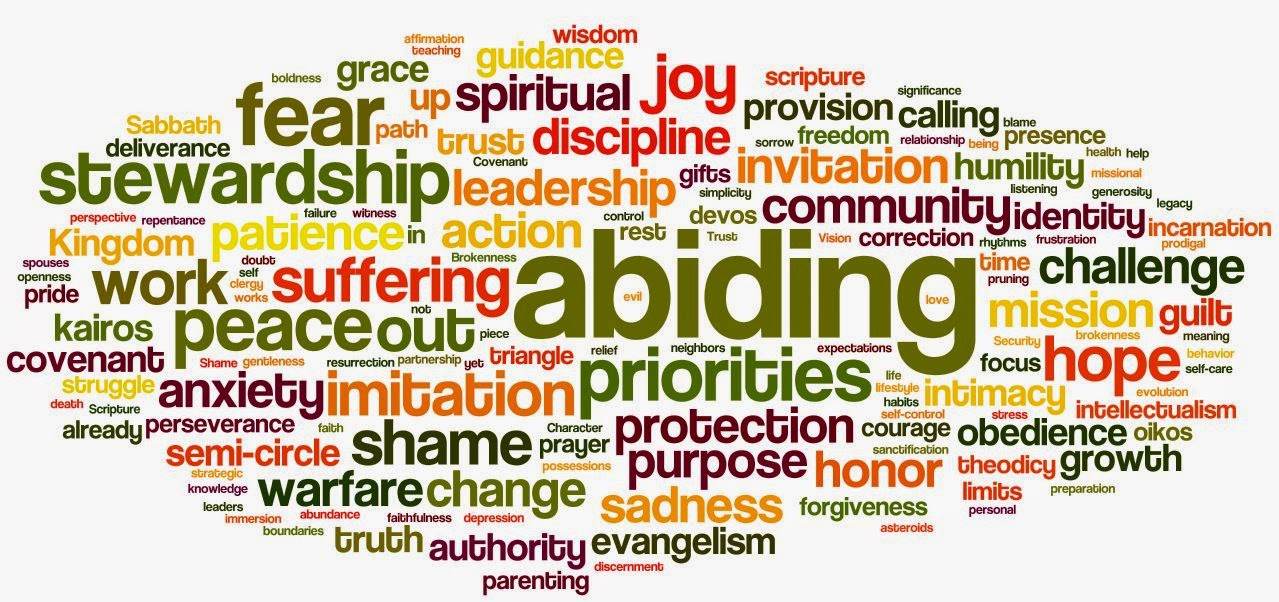
Here's a visual summary of the themes in my personal devotions over the last 12 months:


If you prune that down to the top 20 words, it looks like this:


And if you go all the way down to the top 5 words, you see this:


Not that you really need to know that much about what's been on my heart for the last twelve months as I read and reflect on Scripture of course, but I wanted to share with you the tools I've found that have made this little look-back reflection possible.

First, I've been using a simple journaling format that I learned from Wayne Cordeiro at New Hope in Hawaii.  It uses a SOAP acronym to provide structure (Scripture, Observation, Application, Prayer) and help keep things simple.  I've written more about that before.  What I may not have mentioned is that the journal invites you to create a Table of Contents as you go, and for each entry to record a title and some keywords that identify the themes in what you've written.  Here's what mine looks like:


I've been using this journaling tool for several years now and have begun using the keywords as a window into the past.  (The Table of Contents is also a HUGE asset when you need to find a verse on a topic for yourself or someone else.)

With that list of words as raw material, you can visualize it as above using the website Wordle. Paste your text into the box and BOOM!  A word cloud where the words that appear most frequently are shown in larger font.  Wordle gives you a lot of flexibility on how the visual is created... fonts, colors and alignment etc.  But you can also limit the number of words that will be shown from your content, which is how I made the three versions above.  (You can also make a Wordle from a document, or even from a website.  Try pasting in a whole book of the Bible sometime to see some interesting things about the topics that book is engaging.)

If you're not doing daily devos, I encourage you to start and I recommend the Life Journal as a great tool.  It's been a huge blessing to me!

Wednesday, October 29, 2014

Burning Out?


Wrote this for the blog at my church but thought I'd post it here as well.


Here’s a parable for you:
A MAN ONCE TOOK THE ENGINE FROM HIS LAWN MOWER AND USED IT TO REPLACE THE BROKEN ONE IN HIS CAR. HE THEN CURSED THE CAR FOR POOR PERFORMANCE, AND ALSO RUINED THE MOTOR. ALL ALONG, HE WAS SUPPOSED TO BE MOWING THE LAWN.
Are you the engine?  Are you the “man?”  You may well be both at the same time!
What do you expect out of yourself, out of your life and the others around you?  What does the world and your workplace expect?
What does Jesus expect?
Jesus said – no, scratch that – Jesus says; “Come to me, all you that are weary and are carrying heavy burdens, and I will give you rest.  Take my yoke upon you, and learn from me; for I am gentle and humble in heart, and you will find rest for your soul.”  That’s from Matthew 11:27-29.
I also love, love, love this version from Eugene Peterson’s The Message: “Are you tired? Worn out? Burned out on religion? Come to me. Get away with me and you’ll recover your life. I’ll show you how to take a real rest. Walk with me and work with me—watch how I do it. Learn the unforced rhythms of grace. I won’t lay anything heavy or ill-fitting on you. Keep company with me and you’ll learn to live freely and lightly.”
(By the way… be aware that even if you are a Christian and feel pretty good about that, the actual “religion” you are practicing may well be Busyness, or Other People’s Expectations, or My Own Expectations, or Success, or The American Dream or whatever.  These are killer religions, and burning you out is their preferred form of human sacrifice.)
If you want a job to do and something to work on for Jesus, consider this one: become a living, prophetic witness to a different way of life that gives life, rather than destroys it.

Tuesday, July 16, 2013

Leaning into Transformation in the "Experience Economy"

My friend Rich Melheim posted the following comment about The Experience Economy, a book aimed at secular marketing and business:

"SUMMER READING: In "The Experience Economy" (the only business book I've seen dedicated to the "author and perfector of our faith") the book starts with a value graph, showing that people don't value commodities, goods, or services much any more. We value experiences. By the end of the book, we see that experience isn't even the top value. The top value is transformation. That puts your "service" in the center of things people no longer value. When I say "forget the IHS" (one hour service), I mean the one-way show you put on for people. It has little value any more. Get EPIC (experiential, participatory, image driven, conversational) a la Leonard Sweet."

I've written before about the limited bang for the buck in Sunday morning worship, and affirmed but challenged the relative value we put on large vs. small gatherings in the first blog post I ever wrote, using the food pyramid as a metaphor.   But radical realignment is an unlikely challenge for a congregation to take on.  


Even so, we can use this to frame our thinking.  For conventional-model congregations (i.e. programs, property, professionals and presentational worship), how can you clearly and effectively leverage *each* of those four aspects of your life towards transformation?

And for my friends in 3dm and related movements, (house church, Life Transformation Groups etc.) here's yet another confirmation of your instinct to set aside most of the apparatus of conventional church so that life-on-life can really be your focus.  That is, I'm convinced, where the most fertile soil is for transformation.

Tuesday, July 2, 2013

Anne Lamott Nails It for the Shame Series

This Facebook post from Anne Lamott is so perfect for the whole series I've been doing on shame and the struggle to achieve our own good-enoughness. Anne Lamott.... broken AND beautiful, just like all the rest of us!

Last week, when I was having the experience that almost every writer longs for, I got as mental and confused and low self-esteem as I've been in a while. And everyone I was with was extremely sweet, smart and affirming. It was the damn system that failed, the system I was raised believing in, that I can achieve and impress and people-please SO successfully, that I will finally get the seal of approval sufficient to fill the Swiss cheesey holes in my soul. I will have arrived, finally. Yay

During this pretty high-falutin' experience under the bright lights, w/ kind smart people and FABULOUS make-up, I felt like I'd 9 cups of coffee, two bags of candy corn, a box of chocolate truffles-- Heaven, right? I love being out of my body, tripping on my own fabulousness, mood-altered to within an inch of my life. And then guess what happened? You're going to hate this

It ended. Yes! My turn was over. All the smart kind people--and even my make-up person--TRAITOR!--went on to the next person. 

And then there was just me, even more needy, worried, and self-doubting than usual--had I talked too much? Too fast? I had meant to sound like a cross between Gloria Steinem and Ram Dass--but had just sounded like a very caffeinated ME. Regular old human me, beautiful, slightly nuts, flawed. Trying to tell my truth about God and being human, in my own voice.

Sigh. Then I flew home, to my dogs, my life, my writing, church, etc, and I drank a lot of water, and my friends loved me out of ALL sense of proportion, and I got to do the sacraments that save me--plop and putter. Reading to my grandson. Radical self-care--lots of rest, Wimbledon, salads, rubbing lotion into my fabulous jiggly thighs. Eating delicious low-sugar life-giving foods, with perhaps an excess of cherries and peaches. Okay, and plums. And that one night w/some See's. Getting a little writing done EVERY day, by pre-arrangement with myself, as a debt of honor. Teaching my Sunday school kids, that they are loved and chosen, safe beyond all understanding, and that to be alive in a miracle. 

Home! In my funny gorgeous dumb puttery life! Sweeping the kitchen, singing along with the Beatles. Hallelujah, and wow, and thank you thank you thank you.

Monday, June 24, 2013

"Shameless" Sermon Series, Part Two: "The Shame Game"

Here's the second of my four week series on shame.  We get a look at the core of Brene's insights on shame, and then I make the connection to faith.  In a nutshell, I modify her wise words:
"Let yourself be seen, and believe that you are enough."
to link them to the spiritual reality of the loving God in this way:
"Let yourself be seen by God,  and believe your Father when He tells you that you are enough."
To watch the clip of Brene I refer to, go to bit.ly/browntedtalks and watch the segment from 6:06 to 11:20.

Also, if you want to see the Powerpoint slides directly, as they are hard to see on the video, you can find them here

This series is being done at Gethsemane Church in Maplewood, Minnesota.


Sermon from June 16th, 2013 from Gethsemane on Vimeo.

Saturday, February 2, 2013

Prayer vs. Prayerfulness?

Just wanted to pass along a very nice blog post by Ben Sternke where he talks about the temptation to seek out a certain feeling in prayer ("prayerfulness" as he calls it) rather than simply praying and letting our feelings follow along (or not) as they will. Here's the link and an excerpt below.

"But the trap is that when it is time to pray again, I inadvertently find myself seeking that state of mind instead of doing the activity that brought about the state of mine. I seek the secondary effect (“prayerfulness”) as a primary thing and thus lose both the primary thing and the secondary effect. I end up neither praying nor feeling prayerful! I vaguely try to conjure a certain state of mind and eventually give up, frustrated at how “hard” it is to pray. 
But what I have been learning lately is to abandon the pursuit of “prayerfulness” and simply get down to the business of actually praying. This sounds absurdly obvious, I know, but it has been a profound revelation for me. Just sit down (or stand up, or walk around) and prayJust start praying."

Monday, April 30, 2012

Eye-dentity in the Hurricane of Task

Continuing in my reading of The Message of Hope with the folks at Gethsemane, I wrote a reflection for our Facebook group on Friday that now has an interesting bookend with the one I wrote today:

From Friday, April 27:
Read today where Peter says he's ready to die with Jesus, but a few verses later he can't even stay awake with him. I'm hearing in that a caution not to over promise, either to God or to myself, things I may not be able to follow through on. I'm not Jesus, I'm not even Superman, and thankfully one Messiah turns out to be quite sufficient for the world. I think this is also why I like the story of the loaves and fishes... where the little boy offers up what little he has to feed the thousands. Sometimes I feel like all I've got to offer is a loaf and a fish, but that's okay. My job is just to offer what I've got. It's up to Jesus to multiply it and make it into enough.Read today where Peter says he's ready to die with Jesus, but a few verses later he can't even stay awake with him. I'm hearing in that a caution not to over promise, either to God or to myself, things I may not be able to follow through on. I'm not Jesus, I'm not even Superman, and thankfully one Messiah turns out to be quite sufficient for the world. I think this is also why I like the story of the loaves and fishes... where the little boy offers up what little he has to feed the thousands. Sometimes I feel like all I've got to offer is a loaf and a fish, but that's okay. My job is just to offer what I've got. It's up to Jesus to multiply it and make it into enough.

From Monday, April 30:
In my post on Friday I was connecting with a "who I am not" idea: I am not the Messiah, not even Superman. Today I was struck by the exchange between Jesus and Pilate in Mark 14 (top of p. 64). "Are you the Messiah...?" Pilate asks; "Yes, I am..." Jesus replies. That's a "who I am" moment, very different from the "who I am not" perspective from Friday. I think both ways are useful in dealing with difficult situations, but it strikes me that the "who I am not" approach is kind of like playing defense. In response to external challenges and demands that feel too much for me, I push back against unreasonable expectations. But the "who I am" approach is more like offense. I take the initiative by claiming a clear identity that external challenges can't begin to threaten. In the first, my attention is "out there" but in the second, it's "in here." Rather than starting out in the challenging, task-and-demand-filled world and then retreating into myself for safety and to do what I can, I can start in the security of who the Lord tells me I am, and then move out from there into the world to be who I am.

So. Who am I? I am a Son of the King. Nothing can change that. Regardless of what I do or don't get done today, that is who I get to be. That's the calm in the storm; the eye of identity in the hurricane of task.

Wednesday, January 12, 2011

Navigating the Asteroid Field: Spiritual Growth Practice

One metaphor I keep returning to in my thinking about how to pursue the life of faith with intentionality is the asteroid field.  I haven't yet written about it here. but did bring it up recently over on Felicity Dale's Blog.  The topic there had to do with the tension between tending internal relationships vs. outreach to others, but that raised the question of whether there is a regular "sequence" to these things or not.  (E.g. "FIRST we get close, THEN we can reach out to others.")  In that context I dropped in my thought about navigating in the absence of a stable sequence or pathway.  I think it applies both to groups and individuals.  At any rate, here's the comment from that conversation which will at least introduce the metaphor for us here.


The critique of "sequentialism" resonated with me. It's like the traditional way of navigating where you have a map and a route and just go step by step. But that only works if the terrain stays put! These days I think navigating as a faith community is more like flying your moving spaceship through a field of randomly drifting asteroids. There is no "path," and if you start trying to chart one the asteroids will have moved before you get it finished so it's obsolete before it's done. Navigating in this environment is, I think, done by quick orientation followed by incremental movement, then repeat. And orientation means knowing what's right next to you as well as where you ultimately are trying to go.

In practice, I think that calls for the listening to God and each other that others have mentioned. We Refresh our awareness of where we are and where we are going, then Respond. So the path forward isn't laid out in advance as a sequence A to B to C to D etc. Rather, the sequence is replaced by a discipline: "(Refresh, Respond) Repeat."
I think, if we do that, then the original question about community vs. mission gets answered over and over as God leads.
Thoughts on an (R,R)R practice for faith life?  I'd love to hear them.

Friday, April 16, 2010

Why I Believe

My friend Jonathan posted an interesting question on Facebook yesterday:

Curious: Christian? Why? Or... Non-Christian? Why? Would love to hear your answers. Don't try to convince anyone of anything. Not a debate. Just interested in YOUR response, your story, your heart.

I've though a bit about that over the years, and more so recently, so I wrote a reply which I thought I'd share here too:

Christian. To be quite frank about it, I am a believer because my parents raised me in belief. As Christof says in The Truman Show; "We accept the reality with which we are presented."

More to the point, though - why do I continue to believe? As I have looked at that, two reasons are the most influential.

First, I have an actual sense of the presence of an Other, that resonates with the God of the Bible as seen in the person of Jesus.

Second, the whole belief system that is grounded in my relationship to that Other is something that I find comforting, inspiring, intellectually and emotionally compelling, and integral to my sense of living a life that has meaning.

I guess that's the short answer. ;)

As Jonathan, I'm also curious to hear from others. Why do you believe what you believe?

Sunday, December 6, 2009

How My Mom Introduced Me to God

Part Advent craft for the family, part spiritual autobiography - how's that for a multi-purpose blog post?

One Christmas season when I was a child, my mom had the family do a special activity at home. She set up a little doll-size manger with a small pile of straw next to it and invited us all to "prepare a place for the baby Jesus." We were to add straw one piece at a time over the weeks of Advent. And we were to only add straw when we had done an act of kindness for someone, anonymously.

These good deeds were to be kept secret. It was just between us... and God.

It was a nice activity, and fun in a way that appealed to a young boy who got permission to be sneaky for a change. I don't recall that we ever did it again in the years after that, but by the 25th I do recall there was a decent amount of straw in the manger for the Jesus doll to lie in.

Looking back, it has seemed to me that something really significant got catalyzed in my spiritual life back then. The experience of sharing a secret with God - and essentially engaging in this "spiritual practice" over several weeks - was, as far as I can recall, my earliest clear encounter with God as an actual "other" I could relate to. My first sense of the "Thou" in my "I-and-Thou" relationship (thank you, Martin Buber, for giving me that language some years later.)

So this year, I decided to bring back the manger. I made a little video of how to build one with my daughter Rebecca that you can find below. I think she's already got a stronger spiritual sensitivity that I did at her age, but if this helps to encourage her growth (or mine, or any of the rest of us in the household), well, it's all good.

And anything that encourages more intentional acts of kindness is worth a shot!

Blessings on you and yours this season. May you all share good secrets.


How to Make a Manger from Timothy Thompson on Vimeo.

Friday, October 2, 2009

Driving as a Spiritual Practice

Christine Sine has collected a whole set of posts from people about "What is a Spiritual Practice?" It includes reflections on a whole host of things from running and throwing parties, to smoking, sex and yes, driving.

The driving post caught my attention and I encourage you to check it out here. The author finds six different ways in which we can recognize the spiritual dimensions of this daily activity that often feels empty... something we just have to do in between important things.

I wanted to add one of my own, so here is what I wrote as a comment there:

Just found your wonderful post by way of Christine Sine’s collection on spiritual practices.

I stumbled into driving as spiritual practice first by way of confession.

I noticed that when I merge onto the freeway, I often get irritated if people don’t make at least some effort to let me in. Then when I’m in the right lane, I get irritated by people trying to merge if they don’t take the initiative and end up making me speed up or slow down! I am totally self-centered, and change my sense of the “rules of the road” so that it’s always the other person’s job to make the merge work!

What a sinner. ;) I thank God I can laugh at my self-centered self.

But since then, as I’ve made it my job to intentionally facilitate other people’s merges, I’ve started to hear a phrase from John 14:2 “I go to prepare a place for you.” The phrase is curiously out of context, but even so it has become a part of my spiritual practice of driver’s hospitality.

And, lucky me, I get to engage in this practice over, and over, and over, and over again… every day!!

And blessedly, I am generally less irritated now.

Friday, May 1, 2009

More on Relationships - Movement towards Depth?

Brian made a comment recently voicing concern over the apparent lack of depth often seen in Christian relationships. Here's a sample:
I'm not so sure many people inside church buildings or w/n the crumbling Corpus Christianum know much about relationship as commitment or that relationship entails an ethos of sacrifice. It seems that many Christians opt toward relationship as mere convenience rather than as an expression of faith; buying into the cheapened notion that love is merely a feeling & not much else beyond that. Many Christians have not yet learned to love into relationships when it is inconvenient to them.
I have to say I share that concern, especially because the struggle for substantive relationships seems so deeply rooted in the hyper-individualism that is so characteristic of our age and culture.

With that in mind, you can see why this quote from Phyllis Tickle caught my attention in an e-mail this morning:
"I don't think anybody knows exactly where the Great Emergence is going, much less where the Christianity, emerging/emergent, coming out of it is going to go exactly, but there are some contours that are clearly visible right now and can be described. ... It is definitely communal, even to point that about a quarter of it is probably engaged in a form of monasticism."
I certainly don't see monasticism emerging as the dominant form of Christian life. But I'm sure that the impulse that's driving that expression to grow these days - a hunger for and willingness to pursue substantive relationships - is being felt by many more than just the ones acting on it in that way. So that's encouraging. And there are people at work to nurture that impulse and help others act on it. Karen Sloan is one example. You can watch a video of her discussing it here on TheOozeTV.

What are others seeing in terms of greater dissatisfaction in the Church with "thin" relationships and a willingness to explore ways to find depth again?

Friday, March 27, 2009

A Simple Resource for a Simple Church

Brian over at Faith Practice & Simple Church Movements has posted a wonderful little brochure (still a draft) that offers a description of simple churches. It includes a set of three norms for this kind of church life that are oriented towards practice rather than doctrine.
  • A Rhythm of Presence speaks to the relational foundation, being present to God and each other in ways that are significant and active.

  • A Movement of Renewal speaks to the outward focus of working to bring peace and justice - God's shalom - more fully into the world.

  • A Culture of Blessing speaks to enacting grace in love and gentleness no matter what you do (or is done to you.)
Beyond being explicitly centered on Jesus it is presented without any doctrinal core or theological boundaries. Some may find that to be a weakness, but for the purpose helping to nucleate a broad spectrum of faith communities instead of cloning the one you have I find it to be an attractive strength. I think this comes through most clearly in this one comment in a section of final thoughts; "Communion & baptisms should become a consistent expression of your simple church."

I invite you to take a look at his work and give him some feedback as he continues to develop it. Below are the first couple of introductory paragraphs.

Tim

This simple church brochure is designed for Jesus-centered & Spirit-led communities that revolve around three essential norms of expression: rhythm of presence, movement of renewal, and culture of blessing.

Simple churches share life together through prayer & deep conversation, over meals, in play & recreation, & through adventure in serving those in need. Simple churches actively seek the care of the last, the lost , and the least in our world – always with a gracious invitation to
join us if you’d like & yet whatever your decision we will still treat you with dignity & respect . . . we will treat you as Jesus himself.

And while this brochure does not place an emphasis on restricted religiosity as typified by many fundamentalist expressions of religion it does have a central focus on following and imitating the practices & teachings of Jesus & the rhythms of the Holy Spirit - envisioning the renewed reality of a people unleashed to collectively utilize their gifts & talents not toward service of money, consumerism, & self but in service of the Kingdom of God that Jesus spoke of constantly. (Read more...)


Friday, March 13, 2009

The Magic Purse

So, shameless sell-promotion is okay when you're not selling anything, right? I mean, what's a blog for?

I wrote a short story a while back called The Magic Purse. It's a little fable about scarcity and abundance. Over the years a number of people have downloaded it from a collection of stewardship resources hosted by Luther Seminary and told me that it was helpful to them in their congregations. Cool!

For the last couple of weeks I've been having some more fun with it at my current church. I've used it as the basis for a contest for kids, inviting them to write alternate endings and to create illustrations. It's been fun to see their work! I've created a little website in support of that where you can read the story and the alternate endings and see the illustrations. So if that's intriguing to you, or you're looking for a stewardship resource to use in a creative way, check it out. I think you'll like it.

Thursday, February 26, 2009

Merging Faith, Work and Traffic

Guess it's time for my "monthly" post. Harrumpf.

One of the most fascinating blogs I've encountered is Experimental Theology put out by Richard Beck. He's a gentle writer and brilliant thinker who blogs on faith and science, psychology, philosophy, fuzzy logic, game theory... you get the picture. Oh, and he's done an extended series on Calvin and Hobbes. If you read his blog, be prepared to look up Malthusian on a regular basis.

In his most recent post he shared a chart showing how Americans spend their time:


He brought it up in the context of a discussion about the impact of the rise of the bourgeoisie on the life of Christians and the Church. Some of the comments continued to explore that, but a couple of folks, myself included shared some less philosophical reflections. I wanted to share what I wrote with you here:

I also am interested in how the life of faith is integrated and expressed in each slice of the pie. (Harry Wendt of Crossways.org talks directly about that, even using a pie-chart motif as well.)

For example - as I drive and have to deal with people trying to merge into my lane on the freeway, I've started to hear an echo of John 14:2b "...I go to prepare a place for you." Clearly not what Jesus had in mind, and yet it has made driving in traffic a place where my spiritual life manifests in my own experience and (usually) in my outward behavior as well.

If I was a truck driver, that could open up the bulk of my work life to concrete spiritual expression. Alas, I'm merely a pastor!

But it makes me wonder, how else can we merge work life and faith life in whatever we do, for our own sake and the sake of others?
Concrete spiritual expression for a truck driver - say, that's a good one! Amazing the stuff that pops out when I try and write with my "erudite" voice. ;)